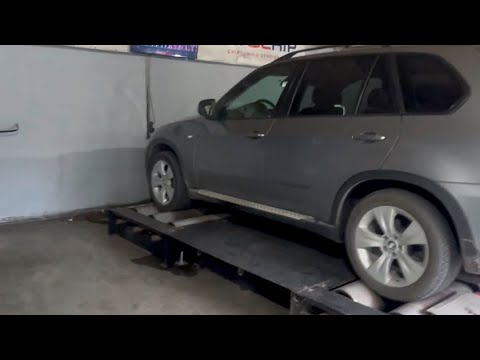
BMW X5 3.0d — turbocharger problem found during diagnostics and dyno testing
BMW X5 3.0d was below its factory power output. Diagnostic logs pointed to a variable-geometry turbocharger problem. Dyno testing and ECU tuning at AUTOCHIP.LV.
 BMW X5 3.0d
ECU chiptuning
Dyno testing
Turbocharger diagnostics
Variable geometry turbocharger
Boost pressure
Data logging
ECU programming via OBD
Diagnostic trouble codes
Power and torque measurement


Should you tune a diesel engine that is already producing less power than its factory specification? This BMW X5 3.0d demonstrates why professional ECU tuning should involve more than simply writing a modified calibration file.
A BMW X5 equipped with a 3.0-litre diesel engine and a single turbocharger arrived at AUTOCHIP.LV for dynamometer testing and diagnostics. Its owner had travelled from Tallinn to find out how much power the engine was actually producing. He had noticed that the vehicle did not always deliver the performance he expected.
The initial dyno test confirmed that the engine was below its factory-rated output. Further diagnostics and data logging pointed towards a problem with the turbocharger's operation. ECU calibration changes subsequently improved the measured power and torque, but the boost-related issue remained and required separate mechanical inspection and repair.
Baseline dyno test: approximately 200 PS
This BMW X5 engine has a factory-rated output of 173 kW, approximately 235 PS, and 520 Nm of torque.
Before changing the engine management software, we tested the vehicle on our dynamometer to establish its actual power output and torque curve.
The initial measurements were:
- Factory-rated power: 173 kW, approximately 235 PS.
- Factory-rated torque: 520 Nm.
- Measured power: approximately 200 PS.
- Measured torque: approximately 440 Nm.
The vehicle was therefore producing around 35 PS and 80 Nm less than its factory specifications.
That difference justified further diagnostics. A dyno test can demonstrate that an engine is underperforming, but it does not by itself explain why. To investigate the cause, we needed to examine how the engine and its control systems behaved under load.
Data logging pointed to a variable-geometry turbocharger problem
After establishing the baseline performance, we carried out a road test with diagnostic equipment connected and recorded live engine operating parameters.
This process, commonly known as data logging, allows requested ECU values to be compared with the values the vehicle actually achieves.
We focused on turbocharger pressure, airflow, Common Rail pressure and injection-related parameters.
The logs showed that the turbocharger was not reaching the pressure requested by the engine control unit. During one of the recorded operating conditions, the values were approximately:
- Requested pressure: 2700 mbar.
- Actual pressure: 2400 mbar.
The difference was therefore around 300 mbar.
Based on the recorded behaviour, the diagnostic data pointed towards a problem with the variable-geometry turbocharger mechanism.
In a variable-geometry turbocharger, adjustable vanes control the flow of exhaust gases through the turbine and help the turbocharger produce the required boost across different engine operating conditions.
If the geometry mechanism does not operate correctly, the turbocharger may fail to reach the pressure requested by the ECU. The engine can then receive insufficient airflow to develop its intended output.
In this case, the logs also indicated an airflow shortfall. Meanwhile, Common Rail pressure and the main fuel-system parameters checked during the test did not show significant abnormalities.
The available evidence therefore directed our attention towards the turbocharger rather than the fuel injection system.
ECU software inspection revealed previously disabled fault reporting
We also inspected the software already installed in the engine control unit.
Although the vehicle had not previously received a complete performance tune, the ECU software had already been modified in other ways.
We found that the reporting of a number of diagnostic trouble codes had been disabled in software.
This can make troubleshooting considerably more difficult. If specific fault codes are suppressed, the ECU may fail to report problems that would normally provide useful information during diagnosis.
There were also indications of previous changes affecting the exhaust and emissions-control equipment, although the exact extent of those modifications could not be established from the available information.
As part of our ECU software work, we restored the previously disabled diagnostic fault-reporting functions so that the control unit could once again register the relevant faults.
Maintaining proper diagnostic functionality is particularly important on a vehicle that already has a known boost-control issue.
ECU programming through OBD using AutoTuner
The BMW's owner was a mechanic himself. After discussing the diagnostic results, he explained that he planned to remove and repair the turbocharger.
It was also decided to proceed with ECU calibration changes while recognising that the unresolved turbocharger issue would continue to limit the engine's performance.
We used AutoTuner equipment to program the ECU through the OBD diagnostic connection.
For supported control units, this method allows ECU software to be written without physically removing the control unit from the vehicle.
Once programming was complete, we checked for diagnostic errors. No active faults were reported immediately after the software update, but this did not mean that the previously identified turbocharger issue had been resolved.
The BMW was then returned to the dynamometer for another measurement.
Dyno results after tuning: almost 230 PS and 548 Nm
The second dyno test demonstrated a clear improvement in engine output even though the boost-pressure problem remained.
| Measurement | Before tuning | After tuning |
|---|---|---|
| Power | 200 PS | Almost 230 PS |
| Torque | 440 Nm | 548 Nm |
| Increase | — | Approximately +30 PS and +108 Nm |
The torque increase exceeded 100 Nm, and the difference between the original and modified dyno curves was clearly visible.
Nevertheless, this should not be considered the engine's full potential. The turbocharger was still unable to achieve the requested pressure consistently under the tested conditions.
ECU tuning cannot mechanically repair a turbocharger. Software calibration can change engine-management behaviour, but it cannot restore a variable-geometry mechanism that is not operating correctly.
Why stronger acceleration does not necessarily mean a healthy engine
This BMW X5 illustrates why subjective driving impressions alone are not enough to assess the technical condition of a tuned vehicle.
If the BMW had simply been remapped without baseline dyno testing or diagnostic data logging, the owner would almost certainly have noticed stronger acceleration. An increase from 440 to 548 Nm is substantial enough to be clearly noticeable in normal driving.
However, without proper measurements it would have been easy to miss the fact that the engine was already around 35 PS below its factory-rated output before tuning and that the turbocharger was still failing to achieve the required pressure afterwards.
A noticeable improvement in performance is not proof that the engine and its supporting systems are mechanically healthy.
This is why we combine dynamometer measurements with diagnostic data logging and ECU software inspection. Each method provides different information about the vehicle's condition.
What work was still required on this BMW X5?
The diagnostics identified variable-geometry turbocharger operation and insufficient pressure under certain conditions as the main unresolved issues.
The owner planned to remove and repair the turbocharger himself. After such a repair, it would be advisable to record fresh diagnostic logs under load, compare actual pressure with the requested values and, if necessary, perform another dyno test.
The video does not confirm that the turbocharger repair had already been completed, and no dyno measurements following such a repair were available.
It would therefore be inappropriate to claim any specific additional power figure that the engine might achieve once the mechanical issue is resolved.
BMW diagnostics and ECU tuning at AUTOCHIP.LV
This case demonstrates why professional ECU tuning involves more than simply writing a modified file to the engine control unit.
At AUTOCHIP.LV, we combine dynamometer measurements, live engine data analysis, ECU software inspection and diagnostics of turbocharger, airflow and fuel-delivery systems.
This approach allows us to assess the results of ECU tuning while also identifying mechanical or electronic problems that may require separate attention.
If your BMW or another diesel vehicle is suffering from reduced power, insufficient boost pressure or disappointing results from previous tuning, a thorough diagnostic assessment is the right starting point.
The accompanying video shows the BMW X5 dynamometer measurements, turbocharger data logs and ECU tuning results in more detail.
Video related to this case
Watch the video for additional details about this job.
Related technical cases