
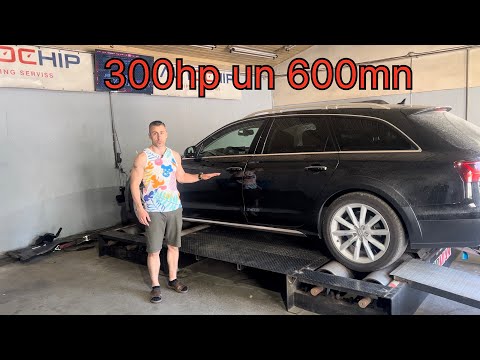
Audi A6 C7 3.0 TDI Stage 1 — from 218 to 299 hp with emissions systems retained
Audi A6 C7 3.0 TDI quattro Stage 1 tuning: 299.1 hp and 586 Nm on a 4WD dyno. ECU data logs, boost analysis and original DPF, EGR and AdBlue systems retained.
 Audi A6 C7
3.0 TDI
Stage 1
ECU remapping
4WD dyno testing
Datalogging
Boost pressure
Fuel injection
Torque limitations
TCU tuning
DPF
EGR
AdBlue
Emissions systems


Can an Audi A6 C7 3.0 TDI be tuned from its factory-rated 218 hp to almost 300 hp without disabling the DPF, EGR or AdBlue systems? At AUTOCHIP, we carried out a custom Stage 1 ECU calibration on this quattro-equipped Audi and recorded 299.1 hp and 586 Nm of torque on our 4WD dynamometer.
What makes this project particularly interesting is that the vehicle retained its original emissions control configuration. Rather than disabling these systems, the work focused on carefully adjusting the engine management software, analysing ECU data logs and respecting the limitations of the existing transmission setup.
Audi A6 C7 3.0 TDI quattro — starting specifications
The vehicle is an Audi A6 C7 powered by a 3.0-litre TDI diesel engine with quattro all-wheel drive. Its factory-rated output is 218 hp and 500 Nm of torque.
Before the ECU calibration, the initial dynamometer run produced approximately 219 hp and 518 Nm. These results were close to the manufacturer's stated performance figures.
The vehicle retained its original emissions-related equipment, including:
- DPF: Diesel Particulate Filter.
- EGR: Exhaust Gas Recirculation system.
- AdBlue/SCR: Selective Catalytic Reduction system for reducing nitrogen oxide emissions.
- Intake flap controls: Components involved in managing airflow through the engine.
None of these systems was disabled as part of the Stage 1 calibration. The aim was to improve engine performance while retaining the vehicle's existing emissions control functions.
Stage 1 results on the 4WD dynamometer
After completing the individual ECU calibration, we tested the Audi again on the four-wheel-drive dynamometer.
The recorded figures were:
- Factory-rated power: 218 hp.
- Power measured before tuning: approximately 219 hp.
- Power measured after Stage 1: 299.1 hp.
- Torque measured before tuning: 518 Nm.
- Torque measured after Stage 1: 586 Nm.
Comparing the two dynamometer measurements, the improvement was approximately 80 hp and 68 Nm. This is a substantial power increase without additional engine performance hardware modifications.
However, torque was not increased without regard for the vehicle's existing limitations. The automatic transmission management system was one of the factors restricting further torque output.
Why did the gearbox limit further torque increases?
Modern engine and transmission control systems communicate continuously. The transmission control unit, or TCU, can influence how much engine torque is permitted under different operating conditions.
For this Audi, the AUTOCHIP technician explained that achieving higher torque would require additional work on the gearbox control software.
The owner decided not to proceed with transmission tuning at this stage. Instead, the vehicle was left with the achieved 299.1 hp and 586 Nm calibration, allowing the owner to evaluate its performance before considering further modifications.
TCU tuning remained a possible future option, but it was not carried out during the work shown in the video.
It is also important to understand that changing electronic torque limits does not increase the mechanical strength of the transmission. Any further calibration would need to take its actual condition and load capacity into account.
Boost pressure data — how much was actually changed?
One of the most valuable parts of this project was the comparison of ECU data logs recorded with the original and modified software.
The technician demonstrated the maximum boost pressure readings observed in the diagnostic data:
- Original ECU calibration: approximately 2575 mbar.
- Stage 1 calibration: approximately 2660 mbar.
The difference is approximately 85 mbar, or 0.085 bar. This indicates a relatively small increase in the recorded boost pressure parameter.
These figures represent values displayed in the ECU diagnostic logs. Whether the pressure is expressed as absolute or gauge pressure depends on the definition of the particular ECU parameter, so no additional conversion is assumed here.
The relatively small boost adjustment illustrates an important aspect of diesel engine calibration: additional power is not achieved simply by increasing turbocharger pressure. Fuel delivery, injection timing, available airflow, torque management and various ECU strategies must work together.
Fuel injection changes after Stage 1
The data log comparison also included the amount of fuel injected by the engine.
With the original software, the maximum observed injection quantity values were approximately 65–66 mg. After the Stage 1 calibration, the corresponding reported maximum values were around 73–74.5 mg.
This represents an increase of roughly 7–9 mg when comparing the relevant readings. These are diagnostic injection quantity values, not measurements of fuel consumption.
Increasing injected fuel quantity alone does not guarantee an efficient power increase. Diesel combustion depends on having sufficient air available for the injected fuel, as well as appropriate injection timing and engine operating conditions.
Excessive fuelling can increase soot production, exhaust gas temperatures and the load placed on emissions control components.
For this reason, the calibration involved multiple interrelated engine management parameters rather than a large change to a single setting. Torque limits, boost control, injection characteristics and other ECU strategies were adjusted as part of the overall tuning process.
Stage 1 tuning with DPF, EGR and AdBlue retained
There is a common misconception that significant diesel performance gains always require the removal or software deactivation of emissions control equipment.
This Audi demonstrates that considerable improvements can be achieved while retaining the existing DPF, EGR and AdBlue configuration.
However, this type of calibration requires particular attention to engine operating conditions. Excessive fuelling can increase particulate formation, while unsuitable temperature and airflow management can place additional demands on the exhaust aftertreatment systems.
The objective was therefore to obtain the desired performance improvement through coordinated, relatively modest adjustments to the key operating parameters.
Retaining emissions control systems does not, by itself, demonstrate that a modified vehicle meets every applicable emissions requirement. Confirming regulatory compliance would require the relevant separate testing.
Engine temperature protection remained active
During repeated dynamometer runs, the technician observed a slight reduction in available power as engine temperatures increased.
This was consistent with an important decision made during the calibration: the ECU's coolant and engine oil temperature protection limits were retained.
Engine management systems can reduce available torque or power when temperatures approach defined limits. During consecutive dyno runs, heat accumulation may therefore influence the measured output.
At AUTOCHIP, these protective functions were not disabled simply to maintain the highest possible result during every test.
Once operating temperatures return to a more favourable range, the ECU may allow higher output again. The exact performance available at any moment still depends on the actual operating conditions.
Preserving temperature-related protection is an important consideration for vehicles intended for regular road use.
Why professional Stage 1 tuning requires data logging
A successful ECU calibration involves more than producing an impressive peak horsepower figure. Understanding how the engine achieves that output is equally important.
During this project, the tuning process included examination of boost pressure, injection quantity, torque-related parameters, temperature information and other engine management data.
Comparing the original and modified logs helps identify how much individual operating parameters have changed. It also provides useful information when assessing the behaviour of a tuned engine with its original emissions control systems retained.
The resulting combination of custom calibration, data log analysis and 4WD dynamometer testing produced a confirmed output of 299.1 hp and 586 Nm.
Custom Audi 3.0 TDI Stage 1 tuning at AUTOCHIP
This Audi A6 C7 quattro is a practical example of a Stage 1 calibration delivering a significant power increase without disabling the original emissions control functions or modifying the transmission software.
At AUTOCHIP, we provide vehicle diagnostics, custom ECU calibration, engine data logging and dynamometer testing. Our tuning approach takes the individual vehicle configuration, mechanical condition and control system limitations into account.
We also work with partner workshops across Latvia and in other countries, enabling customers to access our ECU calibrations through participating specialists.
The accompanying video provides a closer look at the Audi's 4WD dyno results, the original and tuned ECU data logs, and the vehicle's performance following its Stage 1 calibration.
Video related to this case
Watch the video for additional details about this job.
Related technical cases



