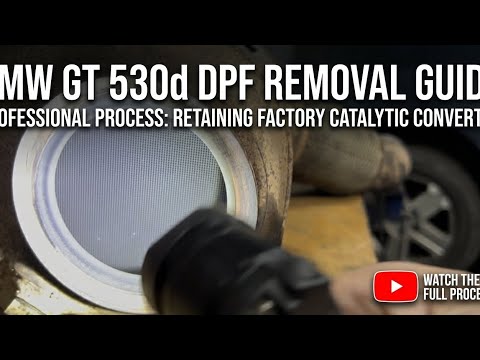
BMW 530d GT — Damaged DPF and Why the Catalytic Converter Matters
BMW 530d GT with a severely damaged diesel particulate filter. Why the oxidation catalyst should be assessed separately and preserved when functional.
 BMW 530d GT
DPF
EGR
Diesel Oxidation Catalyst
Exhaust System
Diesel Diagnostics
Exhaust Smoke


When dealing with diesel particulate filter problems on a BMW, it is important to understand that the DPF and catalytic converter are not the same component. Although both form part of the exhaust aftertreatment system, they perform different functions. Damage to one does not automatically mean that the other needs to be removed or replaced.
At AUTOCHIP.LV in Riga, we worked on a BMW 530d GT with a severely damaged diesel particulate filter. The removed DPF showed extensive physical damage, while the catalytic converter's visible internal structure appeared intact. The catalyst was therefore retained rather than removed together with the damaged filter.
What is the difference between a DPF and a catalytic converter?
A diesel particulate filter (DPF) is designed to trap solid particles, primarily soot, produced during diesel combustion. Its internal ceramic structure contains channels that are alternately blocked at opposite ends. Exhaust gases pass through the porous channel walls, leaving much of the particulate matter trapped inside the filter.
A diesel oxidation catalyst (DOC) serves a different purpose. It promotes chemical reactions that reduce carbon monoxide and unburned hydrocarbons in the exhaust stream. Once the catalyst reaches a suitable operating temperature, these compounds can be oxidised into carbon dioxide and water.
The internal structures are also different. A typical oxidation catalyst uses an open, flow-through honeycomb substrate with a catalytically active coating. Exhaust gases pass through the channels and interact with the coated surfaces.
Unlike a DPF, the oxidation catalyst does not provide the same physical filtration of soot particles. The two components therefore complement one another rather than serving as interchangeable parts.
What was found on this BMW 530d GT?
The BMW's particulate filter had suffered serious physical damage. Its internal filtering element was cracked and broken in multiple areas. The DPF was removed, and its damaged structure was shown during the workshop demonstration.
The catalytic converter was then inspected separately. Unlike the damaged DPF, its visible honeycomb structure showed no obvious cracks or comparable mechanical damage. The technician also demonstrated the condition of the element from the opposite side.
This illustrates an important principle: a broken DPF does not automatically mean that the oxidation catalyst is damaged. Each component should be assessed on its own condition and function.
However, a catalyst that looks physically intact is not necessarily operating at full efficiency. Its active coating can deteriorate without visible cracks. Confirming catalytic performance may require additional diagnostics or exhaust gas measurements.
Why can white or grey exhaust smoke appear after catalyst removal?
One of the main points raised by the AUTOCHIP.LV technician concerns pale, whitish or grey exhaust smoke that can sometimes appear after modifications to a diesel exhaust system.
A functioning diesel oxidation catalyst helps reduce unburned hydrocarbons in the exhaust. If that catalyst is removed along with the DPF, the exhaust system loses this conversion function. Under certain operating conditions, unburned fuel or oil-related hydrocarbons may contribute to visible pale smoke or haze.
However, white exhaust smoke does not automatically indicate a missing or faulty catalytic converter.
Possible causes include injector problems, incomplete fuel combustion, coolant entering the combustion chambers and condensation during cold starts. The appearance of smoke alone is not enough to identify the underlying fault.
For that reason, unusual exhaust smoke should be investigated through proper engine and fuel system diagnostics rather than immediately attributed to a single exhaust component.
How are DPF and EGR problems related?
On BMW diesel engines, the DPF and exhaust gas recirculation (EGR) system both contribute to emissions control, but they operate in different ways.
The EGR system redirects a proportion of exhaust gases back into the intake to help reduce nitrogen oxide formation. The DPF captures soot particles already produced during combustion.
An EGR malfunction can affect combustion conditions and soot production under certain circumstances. This is why diagnosing DPF-related problems may also involve checking EGR operation, injector performance and other engine management parameters.
However, it would be incorrect to assume that every failed or damaged DPF was caused by an EGR problem. Establishing that connection requires diagnostic evidence.
Although EGR is mentioned in the video's title, the demonstration primarily focuses on the damaged particulate filter and retained catalyst. Specific EGR repair or programming operations, and their results, are not established in the available footage description.
Why should functioning exhaust components be preserved?
When repairing a diesel exhaust system, it is important to distinguish between components that have genuinely failed and those that remain serviceable.
Removing a functioning oxidation catalyst can reduce the exhaust system's ability to convert carbon monoxide and unburned hydrocarbons. At the same time, retaining the catalyst does not compensate for the absence of a DPF, which performs the essential task of trapping solid particulate matter.
There are also emissions compliance considerations. Removing a DPF reduces particulate filtration and may cause a vehicle to fail applicable emissions or roadworthiness requirements. For road-going vehicles, the appropriate solution is to maintain or restore a functioning emissions control system that complies with local regulations.
BMW 530d GT — workshop findings and conclusion
This BMW provides a clear example of why the DPF and oxidation catalyst should be treated as separate components during exhaust system diagnostics.
The particulate filter was extensively damaged and removed. The catalytic converter, by contrast, appeared structurally intact during visual inspection and was retained. The accompanying video shows the different internal structures and explains why preserving a functioning catalyst can matter for diesel exhaust quality.
AUTOCHIP.LV provides diesel vehicle diagnostics, engine management checks and fault investigation for DPF and EGR systems in Riga. A technically sound repair begins by identifying the actual cause of the problem and evaluating each component rather than treating the entire exhaust aftertreatment system as a single replaceable unit.
Video related to this case
Watch the video for additional details about this job.
Related technical cases